
Mould Repair & Redesign Mould Repair & Redesign · Any Vendor's Tooling · Quote in 48 h
Extend the life of your existing tooling
- Laser welding and TIG welding repair
- Cavity and core insert replacement
- Re-polishing and re-texturing
Mould Repair & Redesign price, minimum & lead time
Send a drawing, CAD file or sample and we quote from it — within one working day for parts, and within 48 hours for tooling and repairs. No account needed.
- Price
- Quoted after inspection: scope, welding, inserts and machining hours
- Minimum
- One tool — no minimum
- Lead time
- 3–5 days (polish / inserts) · 10–14 days (full cavity recovery)
- Serving
- Delhi NCR, India & export
Built in-house.
End to end.
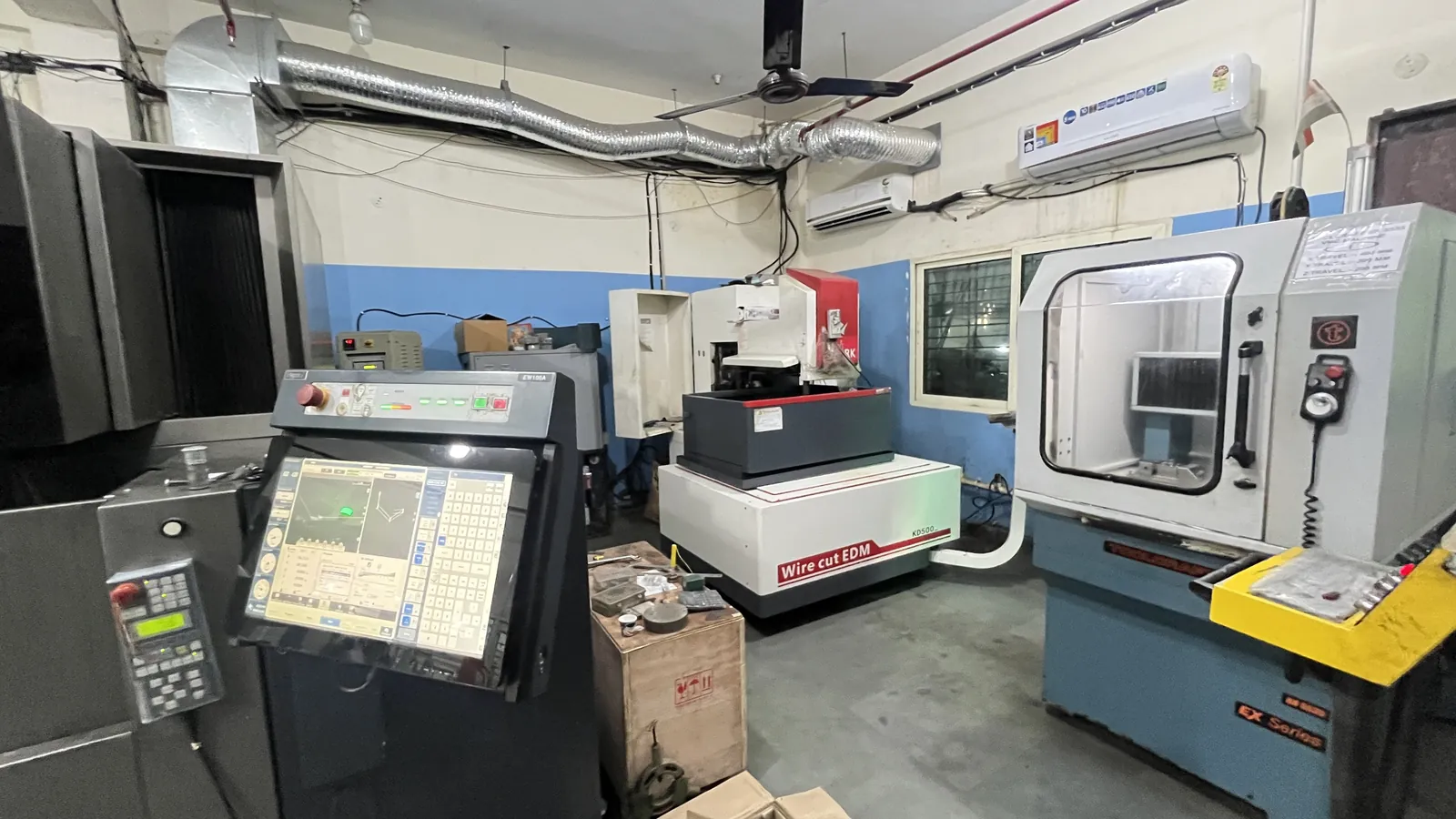
Not every mould needs to be built from scratch. Our mould repair and redesign service extends the operational life of your existing tooling. We handle everything from minor cavity welding and re-polishing to complete insert replacement and design modifications for product revisions. We can also reverse-engineer damaged moulds to create replacement tooling.
A worn or damaged mould does not always need replacing. Our mould repair and redesign service in Greater Noida recovers tooling made by any vendor — TIG and laser welding to rebuild cavity walls, insert replacement, re-polishing and re-texturing, cooling channel changes and gate or runner redesign to cure flash, short shots and weld lines on ageing tools.
Send the mould with its original drawing or a good part and we quote within 48 hours. Minor polishing and insert swaps turn around in 3–5 days; a full cavity recovery with weld build-up and EDM in 10–14 days. Every repaired tool is trialled on our presses and returned with sample parts for your approval.
What we deliver
What buyers order from our Mould Repair & Redesign
Worn cavity recovery
Weld build-up and re-machining to restore the original profile and shut-off.
Insert replacement
Swap damaged cores, cavities or slides instead of rebuilding the whole tool.
Cosmetic defect fixes
Gate, runner and venting changes that eliminate flash, sink and weld lines.
Product revisions
Modify an existing mould for a design change rather than paying for new tooling.
What powers this service
The machines, methods and checks that sit behind every job we take on.
Weld Repair
TIG / laser welding to rebuild worn cavity walls and restore original profile.
Insert Swaps
Replace damaged inserts without rebuilding the whole tool — fastest route to recovery.
Re-polishing
Mirror polish restored after rework so surface finish matches the original part spec.
Gate / Runner Tuning
Redesign feed system to cure short-shots, flash and weld lines on ageing tools.
From brief to dispatch
5 stages — each checkpoint signed-off before work moves to the next.
Assessment
Inspect the mould — identify wear, damage, or design issues.
Quotation
Provide detailed repair scope and cost estimate.
Repair / Redesign
Weld, re-machine, replace inserts, or modify design as needed.
Testing
Run trial shots to verify repair quality and part conformance.
Return
Deliver repaired mould with trial parts for your approval.
Options on every Mould Repair & Redesign job
- Laser or TIG weld repair matched to the mould steel
- Core, cavity and slide insert replacement
- Re-polish to mirror or re-texture to VDI / Mold-Tech spec
- Cooling channel and ejection modifications
- Reverse engineering of damaged moulds for replacement tooling
How we check the work
- ±0.02 mm accuracy after repair
- Trial shots on our own presses before return
- Sample parts shipped with the tool for sign-off
- Written repair scope and cost before any work starts
One supplier for tooling, moulding and finishing
How to order Mould Repair & Redesign
-
Send your drawing or sample
Share a 2D/3D drawing, a reference part or even a competitor sample. We confirm feasibility, material and tolerance within one working day.
-
Quote & tooling plan
You receive a piece price, tooling cost (if a new mould is needed), MOQ and lead time. Existing moulds skip straight to sampling.
-
Sample approval
We mould first-off samples, inspect them against your drawing and ship them for your fit and finish sign-off.
-
Production & dispatch
Approved samples become the production standard. Batches are inspected at every stage and packed to your specification.
Mould Repair & Redesign — common questions
What buyers ask before starting a project: scope, tolerances, tooling, cost and turnaround.
Question not answered here? Send your drawing or a description and we will reply with a specific answer, not a brochure.
Ask a question
Can you repair moulds made by another vendor?
Yes, we regularly recover third-party tooling, including tools with no surviving drawings. Send the tool with the original drawing or a good sample and we will quote within 48 hours.
We are getting flash on the parting line — is that fixable?
Usually yes. We re-machine the shut-off surfaces, weld-build where material has been lost, and re-polish. Press-side shims are a last resort rather than the fix — they mask the problem and it returns.
How long does a typical mould repair take?
Minor polishing and insert swaps: 3–5 days. Full cavity recovery with weld build-up and EDM: 10–14 days. Most jobs land somewhere in between at 3–14 days.
Can you redesign the gating to fix cosmetic defects?
Yes. Weld lines, short shots and sink marks usually trace back to gate placement or runner sizing rather than to the press. We redesign the gating, validate it and prove it on a try-out before returning the tool.
Should I repair the mould or build a new one?
Repair is almost always cheaper if the core steel is sound and the part geometry has not changed. Replacement wins when the cavity has been welded repeatedly, when the tool was under-specified for the volume it is now running, or when the part itself needs redesigning.
We will tell you honestly which side of the line your tool falls on. This guide sets out how we judge it.
What does a mould repair cost?
Repairs are quoted per tool after inspection, because the visible symptom rarely tells you the extent of the work. A polish is a different job from a cavity rebuild even when the defect on the part looks the same.
Photographs of the defective part and the damaged area of the tool make a first assessment much faster — send those with your enquiry.
Can you modify a mould to change the part?
Yes, within limits. Adding material to a part (removing steel from the cavity) is straightforward. Removing material from a part means adding steel — by welding or by fitting a new insert — which is more involved but routine.
Send the revised drawing and the existing tool and we will tell you what is feasible before committing.
Do you maintain tooling for ongoing production?
Yes. For customers running recurring batches with us we store tooling free of charge and carry out preventive maintenance between runs, so wear is caught before it shows up as a dimensional drift on your inspection report.
Other services


Read more about Mould Repair & Redesign
Ready for
your next project?
Share your drawings, volumes and lead time. An engineer — not a bot — comes back within one working day.